This is a January 2026 update to my 2024 post on an increasingly “dvish” Fed and what it could mean for Bitcoin. The core idea is simple: when the cost of money falls, incentives across the economy change—borrowing becomes easier, asset prices respond, and the debate around “hard money” versus “soft money” gets louder. With gold hitting USD 5’000 an ounce recently this should raise awareness of where the US-dollar is headed. It is also important for businesses of every size to understand, because it influences financing costs, investment decisions, pricing power, wage pressure, and how to think about reserves and long-term purchasing power.
The Federal Reserve’s had already in September of 2024 decided to reduce interest rates by 50 basis points when it started to make a pivot in monetary policy, aimed at stimulating economic growth amid rising recession concerns after a period of rate hikes to curb inflation. The easing cycle is continuing into 2026 with the most recent cut in December 2025—a 25 bps reduction that brought the federal funds target range down to 3.50%–3.75%, its lowest level since 2022.
The latest cut reflects a broader move toward cheaper money, alongside a belief among Jerome Powell that inflation is sufficiently contained to justify easing. And this is happening in a political environment where financial conditions matter a lot: heading toward the 2026 midterms, it’s no surprise that political leaders want strong economic optics—rising markets, easier credit, and “affordability” narratives—and there has been visible public pressure on the central bank. The incentives seem to be clear: looser conditions tend to flatter asset prices and reduce near-term stress, while the longer-term costs—particularly inflation’s corrosive effect on purchasing power—are often borne disproportionately by the middle class.
The macro trade-off: lower “cost of money” now, higher risks later
Lower rates reduce the “cost of money”—which can make debt obligations feel less burdensome in the short term. This matters because the state itself benefits from cheaper financing while carrying a debt load reported around $38 trillion (https://www.usdebtclock.org/). When debt and deficits dominate the landscape, the probability distribution shifts toward outcomes that are inflationary over time (more refinancing pressure, more fiscal dominance, more liquidity creation). For the average business owner, it becomes harder to ignore that “holding cash in the bank” can be a losing strategy in real terms.
When individuals and businesses start to feel that slow shrinkage in purchasing power, they naturally gravitate toward harder money—assets that are harder to debase. In aggregate, this dynamic helps explain why gold tends to surge during periods of monetary uncertainty. At the base of it sits a simple monetary idea: Gresham’s law, often summarized as “bad money drives out good.” In practice, people tend to spend the weaker money and save the harder money when they have a choice. At the same time, low interest rates incentivize companies to take on more debt—often to fund expansion or buybacks—which can become a real risk when the cycle reverses and financing conditions tighten again. And while it’s not practical for most people (or businesses) to store gold somewhere, Bitcoin may be a viable alternative because of its superior properties: portability, verifiability, and monetary scarcity.
Impact on Bitcoin in a World of Cheap Money (and Why It Matters in 2026)
The Fed’s move to slash rates can have profound implications for Bitcoin, especially as markets adjust to the reality of cheaper money. Historically, Bitcoin has tended to perform well in environments where traditional assets face headwinds, and the logic is straightforward. When interest rates fall, yields on government bonds and other high-grade credit decline too—so the opportunity cost of holding a non-yielding asset like Bitcoin drops. At the same time, rate cuts are often interpreted as a signal of economic fragility or rising policy risk, which pushes investors to look for alternatives that are less dependent on central-bank credibility. In a sustained rate-cutting cycle—particularly if markets start pricing in further reductions—Bitcoin’s “store of value” narrative tends to strengthen.
This isn’t just a retail phenomenon. As liquidity returns and the cost of capital shifts, Bitcoin increasingly becomes a treasury and capital allocation question for companies and long-term investors: how much exposure makes sense, what role it plays next to cash and short-duration instruments, and how to integrate it without turning the business into a speculative vehicle. The underlying monetary mechanism matters here: by lowering the federal funds rate, the Fed reduces borrowing costs, encourages spending and investment, and injects more activity into the economy. That can support growth in the near term, but it can also raise inflation risks over the longer term—especially in a world of persistent deficits and expanding fiat supply.
In that setting, Bitcoin’s scarcity becomes the key point. With supply capped at 21 million, Bitcoin’s predetermined issuance stands in stark contrast to the flexibility of state-managed money. As money becomes cheaper and more abundant, scarce assets often reprice—not because they “produce yield,” but because the measuring stick is changing. That’s why having a Bitcoin strategy matters more than ever in 2026: without a plan, people oscillate between hype and fear; with a plan, Bitcoin becomes a considered response to a shifting monetary regime. https://bitcoinforbusiness.org/why-every-company-needs-a-bitcoin-strategy/
Conclusion: The Necessity of Separating Money from State Control
The Fed’s rate decisions underscore a critical narrative in the Bitcoin community—the separation of money from state control. By manipulating interest rates, central banks indirectly influence economic activity and inflation, sometimes leading to unintended consequences like asset bubbles and wealth disparity. Bitcoin offers a decentralized alternative, where monetary policy is predefined and immune to the whims of any central authority. This separation could be crucial in maintaining a balanced economic environment where inflation is kept in check without artificially manipulating interest rates.
And while many central bankers still dismiss Bitcoin as a curiosity—or a “non-threat”—history will decide whether this emerging monetary network was underestimated. We will see in time.
As the Fed signaled openness to additional adjustments after the December 2025 cut, understanding the broader macro implications becomes crucial. For Bitcoin, this environment can be bullish because it reinforces the asset’s appeal as both a hedge against inflation and a speculative asset. While traditional markets may see fluctuating fortunes, Bitcoin could continue to solidify its position as a key component of the digital economy, offering both resilience and upside in times of monetary uncertainty.
For those looking to diversify portfolios—or safeguard against looming economic challenges—Bitcoin might not just be an option, but a necessity. On price, my view is that $250k by the end of 2026 is not unlikely, with possible overshoots toward $300k in a strong liquidity-driven cycle. That’s speculation, not a promise—but it aligns with what tends to happen when the measuring stick (fiat) keeps changing.
As the saying goes: “Bitcoin has no ceiling because fiat has no floor.”

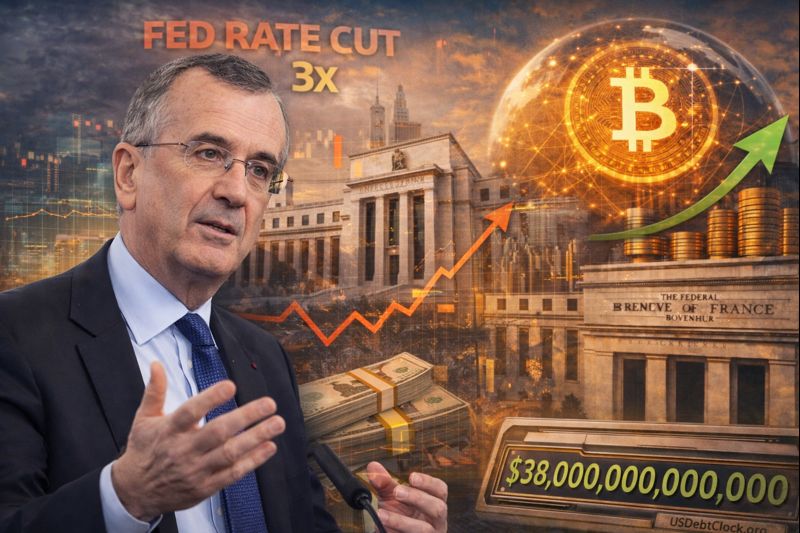
The Governor of the Bank of France doesn’t seem to fully grasp Bitcoin’s model—recently suggesting that people “wouldn’t trust private issuers of bitcoin,” even as Bitcoin operates without any issuer at all.